
St. Augustine once said, “All truth is God’s truth.”
Hey everyone!
Very excited to finally publish this.
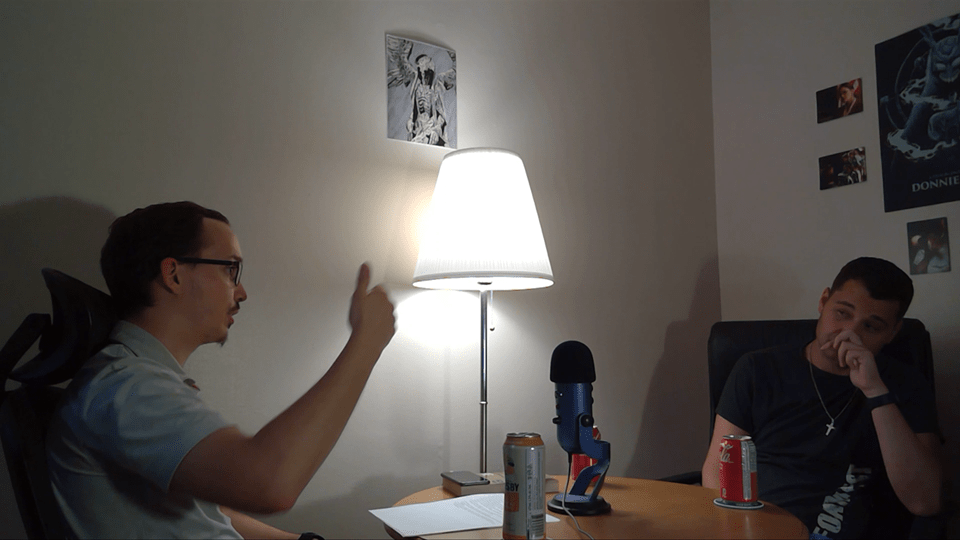
On August 4, 2023, I recorded a conversation with my friend Casey on my podcast. Casey is a Christian who happens to disagree with a lot of the things that I believe in (and yes, the feeling is mutual). The conversation can be viewed here. Casey and I talked about the COVID-19 pandemic, politics, culture, Christianity, biblical scholarship, moral philosophy, and much more for three hours, thus making this episode the longest one I have recorded by far!
As I explained a bit in my previous blog post, I consider myself to be a moral constructivist, which is to say that I believe values are ultimately constructed by human beings. This is what makes the most sense to me after thinking about moral philosophy for over five years, since I am not convinced of God’s existence nor by Sam Harris’ moral realism. Obviously, not everybody agrees with what I believe, which of course is fine. (Casey actually said while I drove him to his place after our conversation that some of what I said in our episode was bordering on delusional, which is a pretty ballsy thing to say to somebody giving you a ride home!)
To prepare for the episode (and also partially out of a newly-found self-interest), I had read a number of books by the New Testament scholar Bart D. Ehrman, seen below. I had read Jesus, Interrupted: Revealing the Hidden Contradictions in the Bible, in which Ehrman reveals hidden contradictions in the bible; I had read Misquoting Jesus: the Story behind Who Changed the Bible And Why, in which the reader is introduced to textual criticism (i.e., the branch of biblical scholarship that deals with reconstructing the original words of the gospel writers); I had also read a good portion of Jesus: Apocalyptic Prophet of The New Millennium, in which Ehrman explains why he believes Jesus was an apocalypticist (namely, somebody who believed that the end of the world was imminent); and finally, I had read a few chapters of God’s Problem: How the Bible Fails to Answer Our Most Important Question – Why We Suffer, in which Ehrman presents answers to the problem of evil as articulated in the bible.

But why have this much interest with this one scholar? Why not study a plethora of resources to get a more balanced view of scripture? Well, to make a short story even shorter, Ehrman used to be a devout Christian, but ultimately lost his faith as he began diving deeper and deeper into biblical scholarship (but not because of it). His inability to provide a solution to the problem of evil that satisfied him led the young Ehrman to become an agnostic atheist. All this to say, the reason I became profoundly fascinated by Ehrman’s books (in addition to his brilliant writing style and ability to explain high-level concepts in a surprisingly accessible way) is because I could trust that his scholarship was not unduly influenced by a state of piety. In other words, I could actually trust Ehrman to lead me to the truth, since his rigorous commitment to it led to him abandoning his faith.
Moreover, his analysis of scripture leans more towards that of a historian or an anthropologist, which to me is a much more justifiable and intriguing enterprise than pure theology. (Note that this does not mean that I am not willing to listen to biblical scholars or theologians that are religious, such as William Lane Craig. The only point I am making here is that listening to Ehrman seemed to be the most efficient way for me to prepare for this podcast episode.)
Anyway, as I explain in the episode’s introduction, my goal with this podcast episode more than anything really was to have a meaningful exchange of ideas with Casey, not to win an argument or “score points” (the name of my podcast is not Rhetoric-Seeking With Jo, after all). If you listen to the conversation in full, what you’ll hear is me asking questions meant to elucidate Casey’s beliefs in addition to doing my best to articulate my own. I believe this is in sharp contrast to my guest, who as far as I can tell was merely trying to win the debate, which in my opinion resulted in the two of us speaking at cross-purposes.
I’ll admit, part of this may have been my fault, since I introduced my guest at the beginning of our conversation as being “one of the best debaters that I know,” which may have set the tone in my guest’s mind. However, the goal to have an actually productive conversation — the kind that members of the so-called intellectual dark web (e.g., Sam Harris, Jordan Peterson, Ben Shapiro, and Joe Rogan, seen below) routinely engage in — sort of goes without saying for me, but I realize now that this kind of thinking is not the norm. To be frank, I wish I would’ve made my intentions clearer from the get-go. It’s not clear to me that doing so would have made a difference in the end, but I still wish I would have expressed my goals more explicitly from the outset.

In any case, in spite of the constant interruptions on my guest’s part and some snide comments that he made, the conversation was still mostly enjoyable.
All this being said, this episode has been hotly anticipated by those around me, and the only reason that releasing this episode took so long was mostly due to the unbelievably tedious work that is video editing. (It is not an exaggeration to claim that I have spent between thirty and forty hours editing this episode). As I mentioned in my previous blog post, I wanted to give this podcast episode the post-production quality that I thought it deserved.
Final note: there was an apparent contradiction that Casey was not able to explain in the episode regarding the day on which Jesus was crucified. After doing some research, Casey believes that this explanation by Jeff Miller of Apologetics Press satisfactorily reconciles the apparent contradiction. I will write a blog post soon in response.
Anyway, I’ll leave it at that, but I do share a number of thoughts in the episode’s introduction (some of which are echoed here).
Please let me know what you think of the episode in the YouTube comments or in the comment section below. All constructive feedback is appreciated!
Until next time!
Jo
 My Peculiar Blog
Leave a comment