
At the risk of sounding grandiose, this blog post may be a historic one.
For about a decade now, I’ve been utterly fascinated by the idea of information being configurable in several different dimensions at once.
I’ve actually been able to produce a number of such structures in writing over the years, though unfortunately, I don’t expect any of those to be published, at least not any time soon, mainly because of their personal nature.
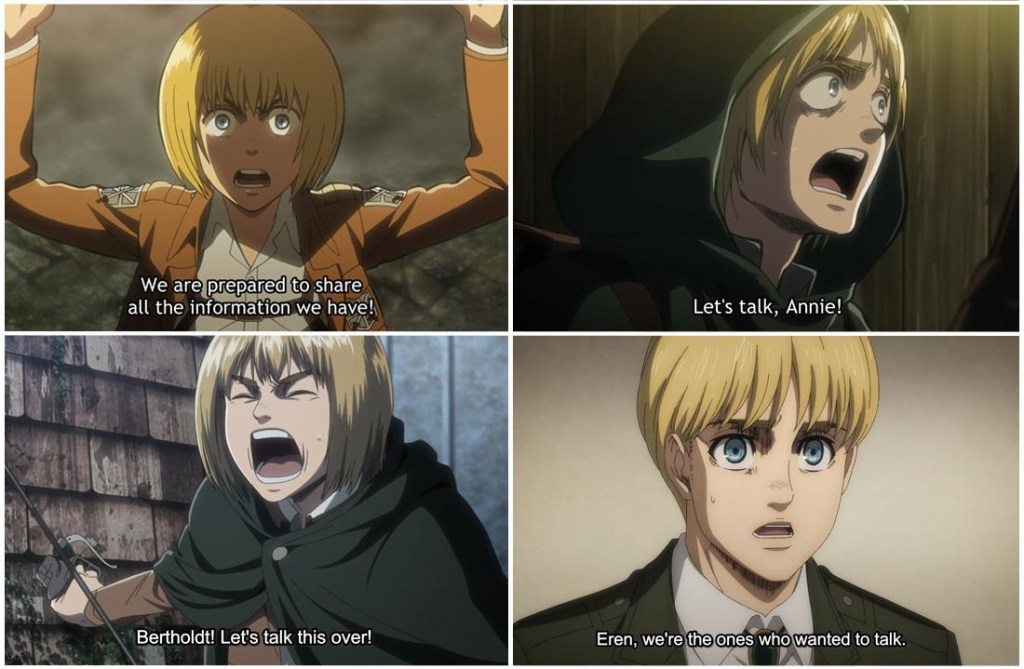
For instance, those who know me in real life probably know that my family is pretty dysfunctional. To give a bit of context to my other readers, for a little over two decades now, there have been a staggering number of conflicts between members of my immediate family. One conflict ignites, then two people don’t talk for a certain number of years (or decades), then another conflict begins, but people don’t want to talk about the conflict despite insisting on resolving it… Other members of my family are not as inclined as I am to talk about problems in order to resolve them, which always struck me as a bit silly, since I don’t believe that “pretending that the problem doesn’t exist” is a good way to solve any problem! I’m often reminded of scenes from Attack on Titan in which one character pleads to another that they at least try talking things out, before being met with nothing but indifference or hatred.
In a sincere effort to create order out of this seemingly insurmountable chaos in my family, I’ve occasionally written emails that blended art, philosophy, spirituality, truth (factual, moral, and aesthetic), and love—some of which might be best captured in the Christian idea of the Logos—all of which was creatively stitched together across several layers of meaning. This was always meant as a call to action (when directed at someone in my family), specifically to do the right thing and to allow myself and them to work collaboratively to create order out of the chaos that was surrounding us, or in other words, to have difficult conversations together, a seemingly alien concept to my family.
To give one example, an email I sent to my father for his birthday some years ago began by talking about a video game series that we were both fond of when I was growing up. I identified patterns in that story (the duality of order and chaos was one of the patterns I discussed), and then talked about the same patterns in a movie series that we used to watch together when I was growing up, before zooming out a bit more and discussing the existence of these patterns in various world mythologies. I then linked the second mythological story I talked about to numerology and then moral philosophy. Next, there was the climax of the email, which was nothing short of a monumental crescendo of information that was meant to emphasise the email’s message (and its depth) before finally wrapping everything up as elegantly as I could and offering to take him out for a movie and a lunch. The email was as true, warm, inspiring, and meaningful as I could make it. In fact, curiously enough, upon rereading the email this week for the first time in a few years, it seemed to be “glowing.”
Unfortunately, in spite of my best efforts, it did not end up being particularly well-received. My offer for a movie and lunch was refused with no meaningful explanation, and in a sharp contrast to my email’s tone, the reply was arrogant, something that my father surprisingly admitted in his email “to allow me to be on the receiving end for once,” and it was also quite cold, rude, indifferent, and discouraging, not in the sense of me being discouraged after having read it (although this is also true), but more in the sense of my father was actively discouraging me to reconciliate with my sisters (in a strange paternalistic manner, he literally told me to “get over it”). In any case, I’m still very proud of that email that I wrote. I think I was able to achieve something fairly unique and remarkable, even if my father could not appreciate it.
To give another example, over the pandemic, my mother and I got in an argument that we haven’t been able to resolve. After exhausting all my options of trying to communicate with her productively, I ended up writing to her an admittedly long email, which was also the byproduct of several layers of meaning coming together, including art, philosophy (moral and epistemic), truth (literal and metaphorical), and love. I’m sorry to say that this email was also not particularly well-received… 😬 Ah well. All I can do with my family members (and anyone else in my life, for that matter) is be the environment that allows them to grow. After all, you can lead a horse to water, but you can’t make him drink!
To give a more recent (and hopefully less depressing) example, earlier this year, my then-girlfriend broke up with me. Thankfully, it was an amicable breakup, but still, we had been dating for almost five years, so needless to say this was a difficult thing for me to deal with.
I ended up writing a letter to her, and I’ve been asked what the purpose of this letter was. The best I could come up with was something along the lines of “to capture the goodness of our relationship in writing,” but I suppose to some degree, it was also to eternalise this goodness.
Again, here, I tried to stitch together several layers of meaning in order to produce something that would resonate with the target audience on the deepest level possible. I won’t go into details as to the structure itself, but I’m happy to report that unlike the emails I sent to either of my parents, this letter was actually well-received! 😊
The reason I’m talking about all this is because I believe it is possible to arrange information together in a way that spans multiple dimensions. I, myself, have been fortunate enough to have seen or experienced several of these “higher-dimensional structures of information” (HDSIs), which then allowed me, over the years and in my personal life, to produce some of my own.
I think I’m now ready to start discussing these ideas publicly. I believe some of the ideas may be beneficial to mankind, and thus I would be remiss to keep them to myself.
I had initially planned to begin broadcasting these ideas publicly via fictional stories, but I think that my fictional storytelling enterprise is on hold for now. I have (very) preliminary ideas for fictional stories I want to write, but I think this will have to wait until a later time, perhaps when I have more time!
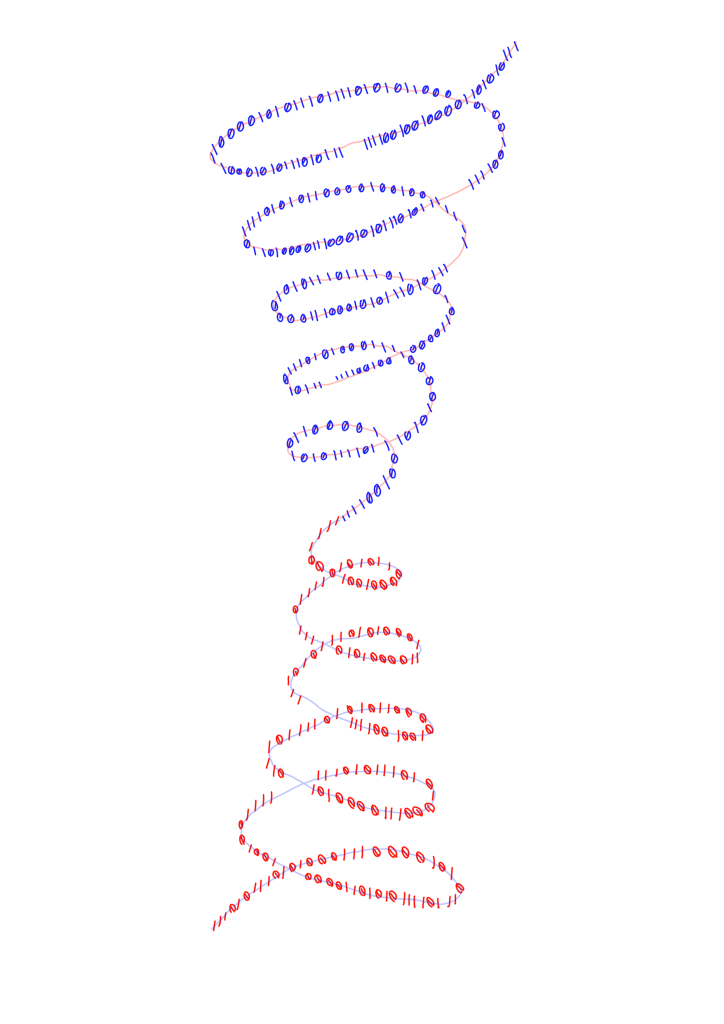
So then, would you like to see what an HDSI looks like? See below for one I drew a few months ago!
So what the hell are we looking at, exactly?
Here, I was able to express information across three different dimensions at once.
The first one, and perhaps the most obvious, are the colours. Probably contingent on the colours of the pen I had available when I first drew this on paper a while ago, we have a blue that is not too dark or too pale; very close to ocean blue (Hex #141FFB). We also have red, bright and vibrant, as its humble counterpart (Hex #FF1105). Given that human beings are primarily visual creatures, the colours usually jump out first and foremost when we view information.
Second (and probably a close-second), we have the physical dimensionality of the information: the fact that the information is spiralling in three dimensions. Every single one and zero has, in theory, an unambiguous, precise, and indisputable , , and coordinate. These coordinates identify the absolute location of the information in the space in which they are contained.
Finally, we have what I would suspect is the least obvious type of information (though I would understand if someone argued the opposite), and this would be “raw” information, for lack of a better word. The ones and zeroes spiralling outward are not random. Much the opposite! They contain information that is encoded…
This one will require some explanation, so please bear with me.
In mathematics, we use different numbering systems for different applications. When working with computers, the binary system (base 2) is often the most useful as electrical signals (on or off) can be converted into information (ones and zeroes). We call this base 2 because there are two digits that we work with (namely, 0 and 1) before going into double-digit numbers. So then, we have 0, 1, and then we have 10, 11, 100, 101, 110, 111, 1000, and so on.
When teaching children how to count, the decimal system (base 10) is the most intuitive since we have ten fingers. Here, of course, we have 0 to 9, then 10 to 99, then 100 to 999, etc.
Hexadecimal (0 to 9, then A to F, then 10 to FF, then 100 to FFF, etc.) is often used in computing as a dense representation of binary values (since 0000 can be represented as 0, 0001 can be represented as 1, and so on until 1111 can be represented as F). This would be considered base 16 because there are 16 digits that we work with (0 to 9, which is ten digits, and then A to F, which is six more digits) before going into double-digit numbers.
So then, if hexadecimal uses the letters A to F, what if we had a system that used the letters A to Z? As it turns out, that is exactly what base 36 is. We have 36 digits to work with (0 to 9, which is ten digits, and A to Z, which is 26 more “digits”) before having to use double-digit numbers. In this case, we’d have 0 to 9, then A to Z, and finally 10, 11, […], ZY, ZZ, and then 100, 101, […], ZZY, and ZZZ, and so on and so forth.
Well then, this looks like a perfect system to encode some information from English (or most other Germanic languages) to binary, no? Say we wanted to convert “jo” from base 36 to base 2; what would that look like? According to WolframAlpha, that would be .
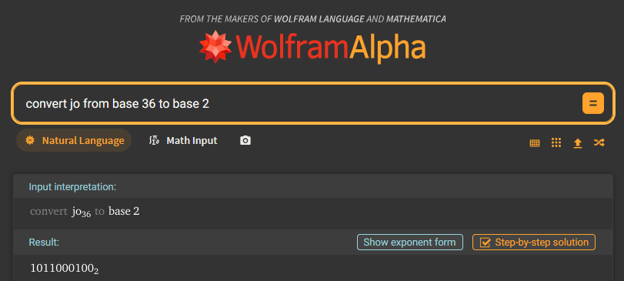
Wow! So we can actually convert words and ideas into raw information. Isn’t that neat?
Well… what would “information” look like in base 2?
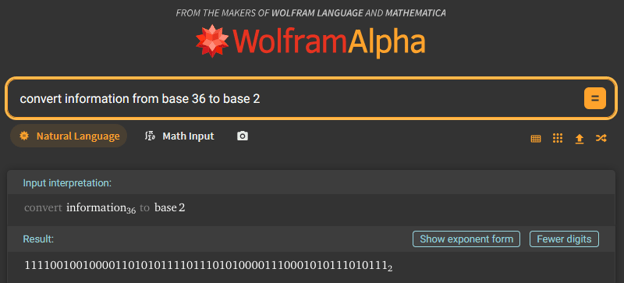
Yep, “information” in raw binary information becomes , which you’ll notice is exactly the repeating pattern we see in the spirals of information! So then we have “information” encoded within information… I call this “information nesting”!
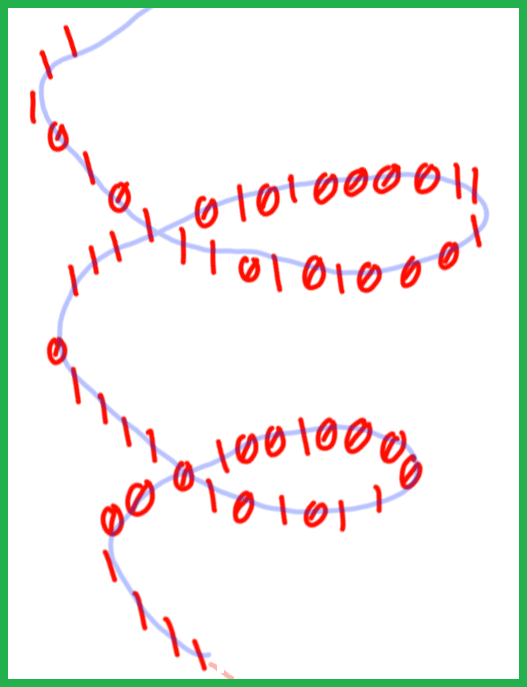
If anyone cares for the story as to how this idea popped in my head, at my old place, after taking a non-trivial amount of THC, I had a very peculiar idea that I wanted to draw multicoloured spirals of information. I still have the original paper if anyone ever wants to see it, but I honestly just grabbed a blank piece of paper, a red pen, and a blue pen, and began drawing red and blue spirals of zeroes and ones that intertwined with each other. If I’m not mistaken, this was earlier this year, in 2026.
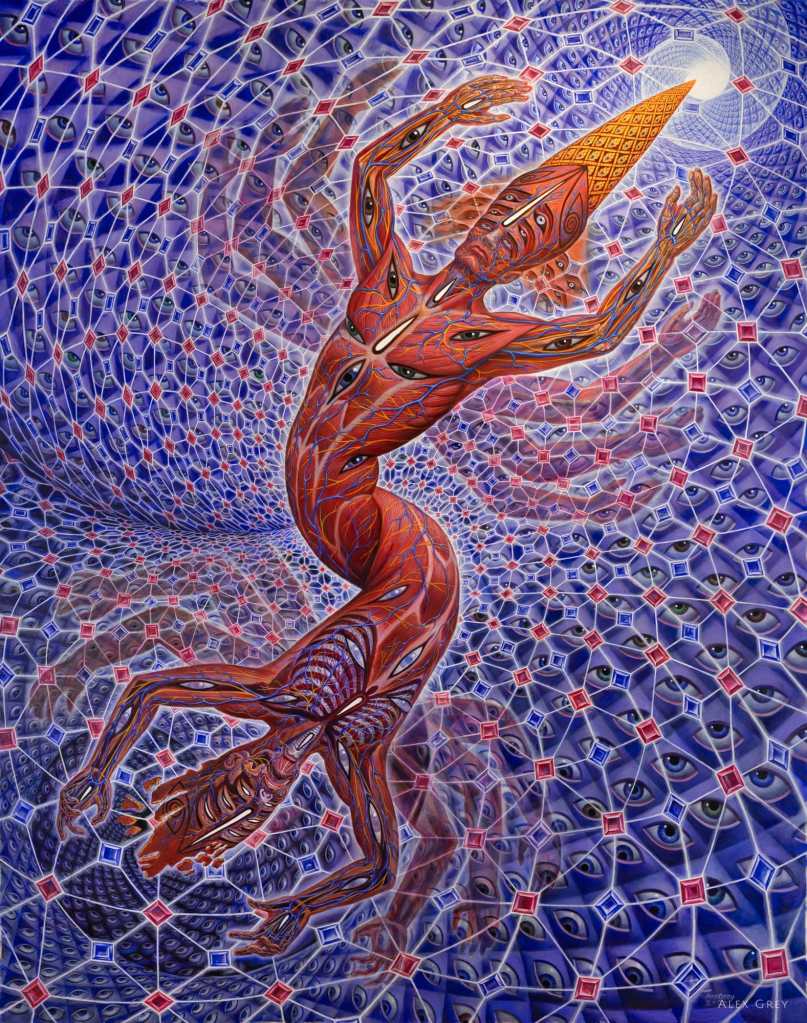
A few months ago, after moving into my new apartment, I decided I wanted to recreate this idea digitally, so I downloaded Krita, a digital painting software, for my tablet. I had tried to recreate my original idea faithfully, but the intertwining of the spirals was a bit convoluted and did not look very nice. I thought hard until I remembered an Alex Grey piece that always resonated deeply with me, The Great Turn (available to view by clicking here or below), so I ended up rotating one spiral so that it was facing in the opposite direction as the other, and after mirroring it, found that it meshed elegantly with the other spiral.
If anyone is curious, examples of written HDSIs in world literature include books like the Bible (which I believe Dr. Jordan Peterson described as the first hyperlinked text in the world) and James Joyce’s Finnegans Wake (a seemingly impenetrable book often described as holographic and psychedelic).
So then, I hope you’ve enjoyed reading about higher-dimensional structures of information (and even seeing what one looks like!). I may try to publish more of these in the future, though they seem to be hard to represent visually. I suppose the abstractness is the reason why…
Until next time!
Jo


Leave a Reply